
A designer’s guide to the different types of timber veneer cuts and matching techniques
03.03.26


What is timber veneer?
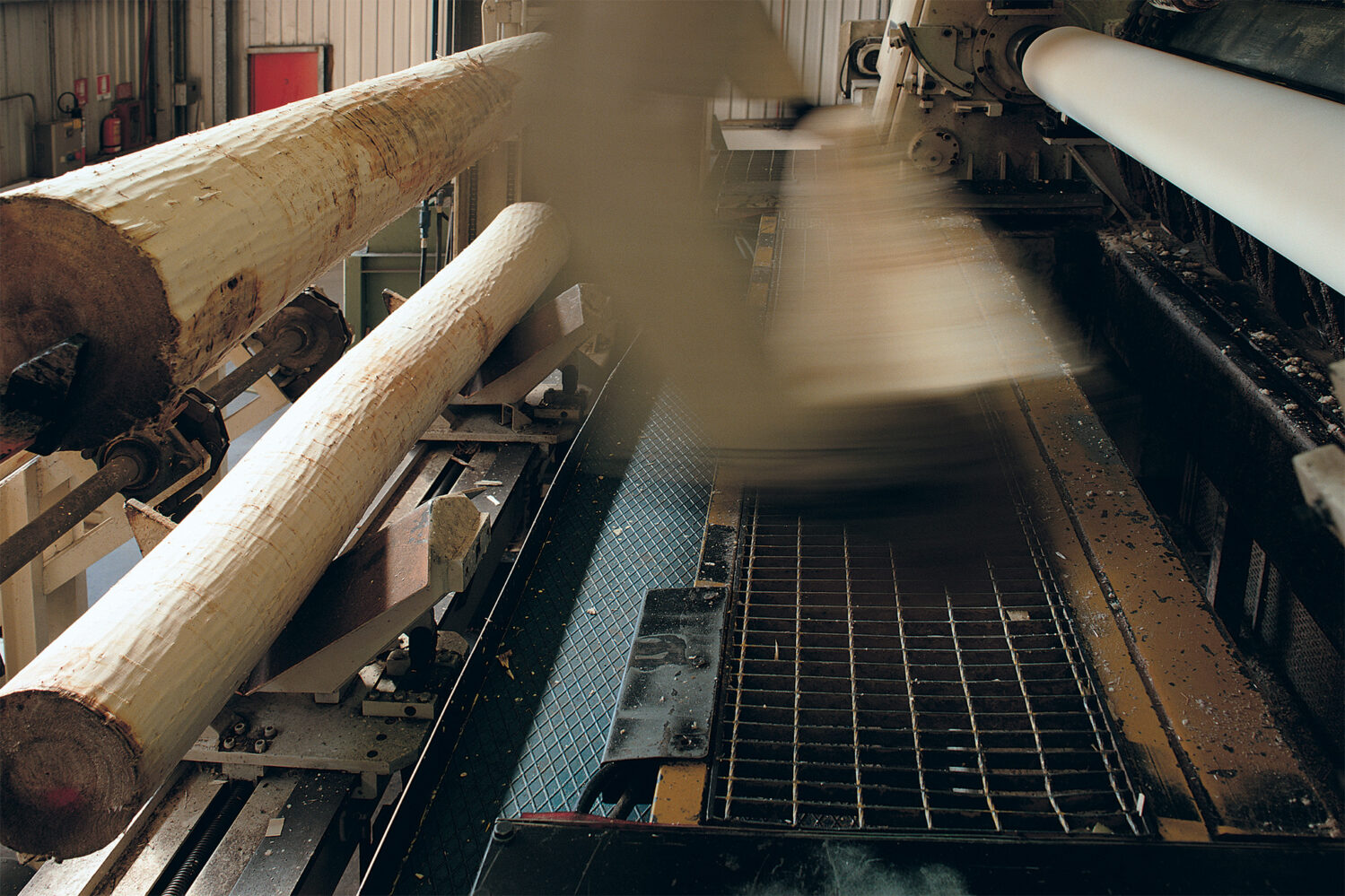
Timber veneer is created by slicing thin sheets from a log and joining them together as a sheet or layon.
Unlike solid timber, veneer maximises material efficiency. Meaning a far more usable surface area can be produced from each log, making veneer a more sustainable and predictable choice.
Cut methods: How a log becomes a surface
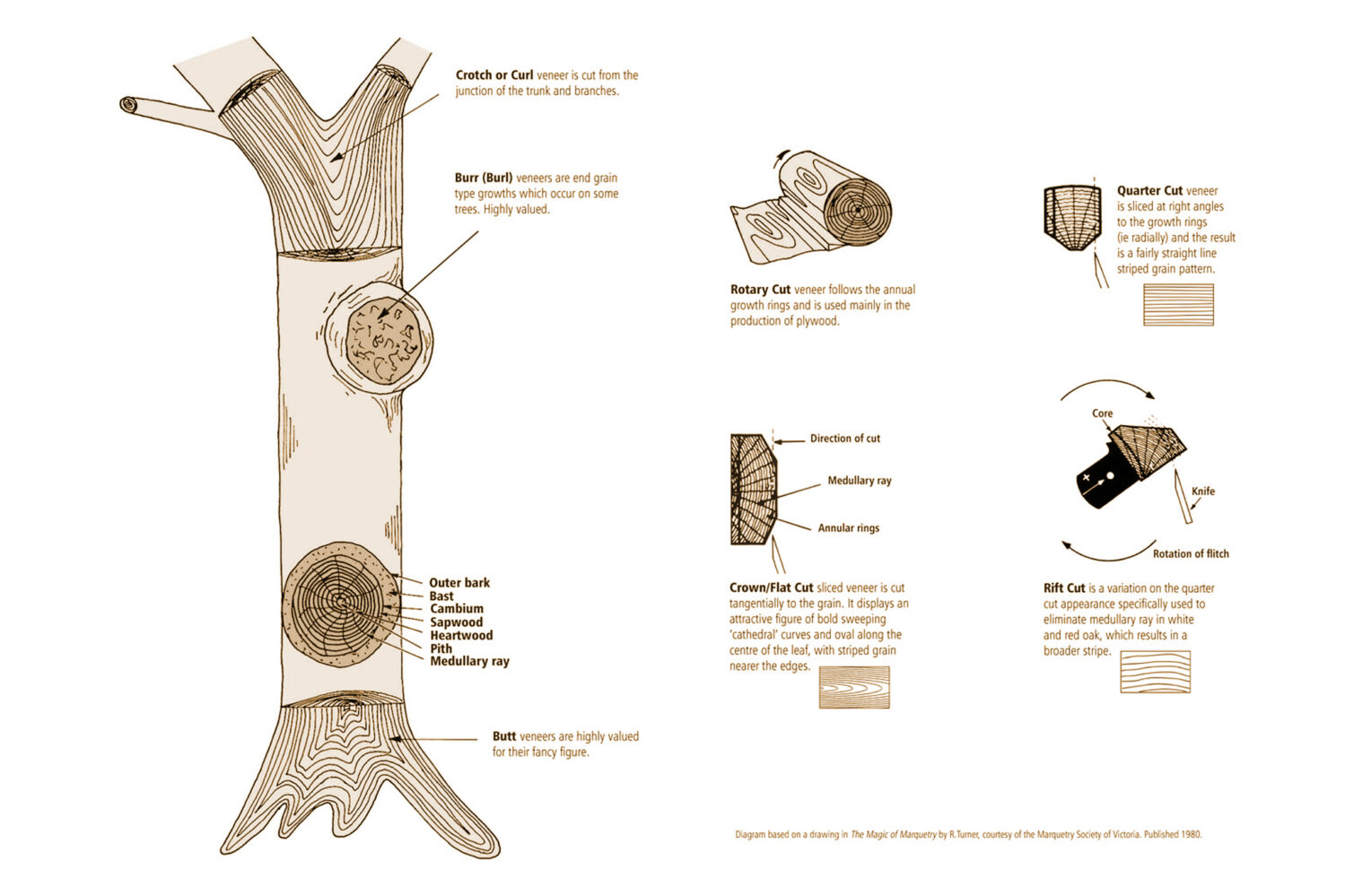
The way a log is processed and sliced determines the grain pattern of the veneer. The most widely used slicing methods are crown cutting and quarter cutting while peeling produces a rotary cut; each method brings a distinct visual effect.
Crown cut veneer (crown veneer):
Crown cut veneer—also known as crown, flamed or cathedral—is produced by slicing parallel to the length of the log. The log is halved and sliced lengthwise, allowing the cut to sweep across the growth ring pattern.
Visual characteristics:
- Large, expressive “cathedral”, “flame” or “crown” figures
- Pronounced, organic grain movement
- Gradual change across the sheets
Best for a multitude of options, including feature joinery, bespoke elements in residential settings, wall panels and any space where a lively, decorative grain is desired
Crown veneer works particularly well with species such as Walnut and Oak, where the natural cathedral form is both visible and desirable.
Quarter cut veneer:
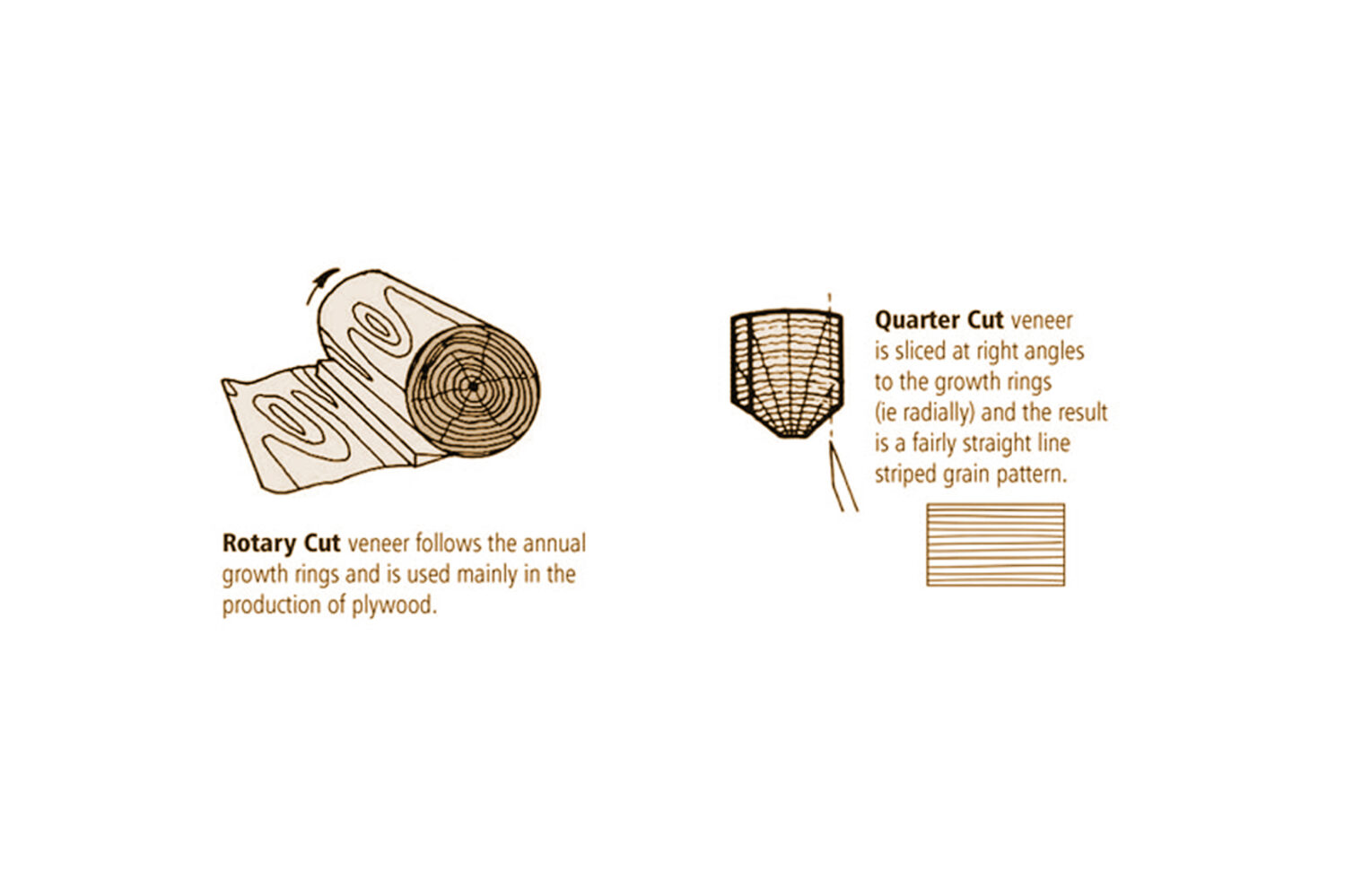
Quarter cut veneer is created by slicing the log at right angles to the growth rings. The log is first quartered, then each segment is sliced from the centre to the outer edge.
Visual characteristics:
- Straight, vertical linearity
- Relatively consistent grain pattern
- Minimal variation between sheets
Quarter cut patterns are best for those seeking contemporary and minimalist interiors. It’s ideal for commercial fitouts as the consistency works well across large-scale joinery and situations where pattern repeat and tonal control are important.
Quarter cut veneer is equally popular in high-end residential projects seeking a calm, architectural rhythm.
Rotary cut veneer:
Rotary cut veneer is created by peeling the log around its circumference, following the curvature of the annual growth rings. This creates a bold, variegated grain, and enables very wide leaves to be produced, making it the highest material yield.
The log is peeled, with a razor-sharp blade from the outside in like peeling an apple.
Visual characteristics:
- Broad, expressive grain movement
- Sweeping, irregular ovular patterns
- Greater natural variation between sheets
Rotary cut patterns suit projects where a bold, organic timber expression is desired. The large sheet sizes make it especially practical for extensive wall panelling or joinery elements where uninterrupted coverage is beneficial, even if the grain is less predictable.
Rotary peeled veneer is also used as the base veneer to create recomposed veneers, such as Eveneer Raw ALPIlignum, assuring maximum yield from the log and supporting a process which creates the most useable veneer sheets for modern joinery applications.
Matching techniques: Book-matched and slip-matched veneers
After the veneer leaves are sliced, they are numbered and bundled like the pages of a book – thin consecutive sheets in a repeating order. How these sheets are laid out determines the final effect.
Book-matched veneer
Book matched veneer is produced by flipping every second sheet, so the grain is mirrored on the adjoining panel – much like opening a book. This creates a symmetrical, ‘butterfly’ effect.
Key characteristics:
- Strong visual harmony and symmetry
- Ideal for decorative focal points
- Highlights the natural pattern of crown cut veneer
Book matched veneer is often used on wardrobe doors, wall panelling, reception counters and statement joinery. It amplifies crown cuts beautifully by mirroring the cathedral forms across a panel, as can be seen in this project – Retail First by Push Architects, featuring Eveneer WoodWall in Spotted Gum Crown.
Slip-matched veneer
Slip matching arranges consecutive sheets side-by-side without flipping them. The result is a clean, repeated grain flow.
Key characteristics:
- No symmetry, a repeated pattern
- Especially suited to quarter cut veneers
- Eliminates the light/dark effect that can appear in book matching (caused by the front and back faces of the veneer reflecting light differently)
Slip matched veneer is often used in commercial interiors, contemporary kitchens and anywhere designers want a refined finish, as seen here in Raven House by KB Projects.
Mismatched or Planked
Mismatched veneer is a decorative technique where veneer leaves are joined in a random order and orientation to create a more rustic or casual ‘planked’ effect.
Mismatching intentionally mixes different grain patterns and colours from various logs or flitches and is often used to spread natural features such as knots more evenly across a sheet, or to maximise the number of similar looking sheets for large projects. Mismatching results in a more varied, yet homogenous, look.
Key characteristics:
- Visible variation in grain, tone and pattern
- A casual, natural aesthetic echoing solid timber boards
- Greater homogeneity over large areas.
Mismatched or planked veneer patterns highlight timber’s natural diversity, embracing knots and tonal differences that would be undesirable in more controlled matching techniques.
Because of their homogeneity, planked veneers are particularly effective on large surfaces where a more expressive, textural quality is desired – wall panelling, wardrobes and feature joinery are common applications. They are frequently used in hospitality, retail and residential settings where designers want the warmth and honesty of solid timber, such as Addisons Workplace by Studio Tate.
Choosing the right veneer for your project
Different types of timber veneers suit different applications.
Here’s a quick overview:
Timber cuts
- Crown: Best for expressive, decorative statements
- Quarter: Best for consistent, architectural spaces
- Rotary: Highest yield and bold variety
Timber veneer patterns
- Book matched: Best for symmetrical or high-impact joinery and panelling
- Slip matched: Best for seamless, minimalist joinery
- Mismatched of planked: Best for the look of solid timber planks and a more rustic feel across large surfaces
When specifying veneer, consider the atmosphere you want to create – is it expressive and organic, or refined and linear? The cut and matching method work together to determine the final effect.
Sustainability snapshot
Timber veneer uses significantly less timber than solid wood, while still delivering the natural grain designers value. Designed, or recomposed veneers, amplify this benefit further, using responsibly sourced timber to recreate consistent patterns and reduce waste.
Elton Group’s Eveneer Raw ALPIlignum veneers ensure repeatability and supply stability – important for large scale projects such as multi-residential developments, where uniformity across dozens or hundreds of panels is essential – while Eveneer WoodWall’s innovative veneer slicing results is 300% greater yield.
Explore Elton Group veneers
The best way to understand veneer is to see it up close. Designers and specifiers can order samples or call your Elton Group representative to see larger sheets so you can experience it in natural light and the project’s context.
Head to the eltongroup.com/about-us/ for more.