




From the beginnings of the Memphis movement in Italy, to crafting a never-seen-before timber pattern with ALPI that is still in use today, we trace the trajectory and legacy of Italian radical designer Ettore Sottsass.
Milan, early 1980s
At the end of 1980, a group of designers gathered at Ettore Sottsass’s home in Milan. By the end of the evening, they had formed a collective, with Sottsass, then 63, as its leader. The group took their name from a Bob Dylan song, Stuck Inside of Mobile with the Memphis Blues Again, which was a little absurd but suited their mission perfectly. There was no wish to become another serious movement of Italian design. Instead, the group wanted to see what would happen when furniture was allowed to be loud, funny, decorative and expressive.
The first Memphis collection was presented in 1981 during the Milan Salone del Mobile, with 55 objects part of the show, including Sottsass’s Carlton and Casablanca bookcases and Martine Bedin’s Super lamp on little wheels.
Crowds thronged to see the exhibition, and within months the collection began touring internationally. It kick-started a debate about taste, ornament and what design was for.
Simultaneously, in the Romagna hills, a family of wood specialists, known for their innovation in the production of sustainable timber veneers, was paying close attention to Sottsass. And what eventuated became one of the longer collaborations of Sottsass’s career, ultimately producing a surface that is still being made today.
A designer of surfaces
By the time Memphis was founded, Sottsass had already spent most of his working life thinking about surfaces. Born in Innsbruck, Austria, and growing up in Italy, he trained as an architect in Turin, going on to design machines and office furniture for Olivetti, alongside creative pursuits in ceramics, glass, writing and photography. Across all of it, he treated pattern and colour as design tools in their own right, equal in importance to form and function.
His most influential surface work was in plastic laminate. Sottsass first experimented with the material in 1966, on his Superboxes, tall laminate-clad cabinets that read as monoliths. Between 1978 and 1980 he filled a notebook with decorative motifs for furniture. One became Bacterio, a pattern he abstracted from the carved surface of a Buddhist temple in Madurai, India, into a dense field of black marks. These patterns became the palette Memphis built its furniture from. While laminate gave Sottsass the freedom to apply any image to any surface, it could not offer the depth and character of wood. For that, he needed a different kind of collaborator.
A family of wood
ALPI began in 1919, when Pietro Alpi opened a cabinetmaker’s atelier in Modigliana, a small town in the Romagna region of northern Italy. In the 1950s his son Valerio led the business away from furniture making and into the industrial production of panels and veneer for Italy’s growing furniture industry. In 1961 the company introduced ALPIlignum, a recomposed veneer that remains the core of ALPI’s production today.
The process is exacting. First, logs of fast-growing species, principally poplar, lime and ayous, are peeled into thin sheets. The sheets are then dyed by immersion, then glued and pressed together over a 3D mould to form a new block. When the block is sliced, the edges of the layered sheets appear across the face of the veneer as grain.
The process creates real timber with a figure that can be controlled. Its colour, scale and rhythm are all created in advance, which means a grain can be designed. By the early 1980s, ALPI had the technology to ‘draw with wood’, and Vittorio Alpi, a young man at the time, and the third generation in the ALPI business, recognised that Sottsass had a unique design language ready to be translated.
Drawing with wood
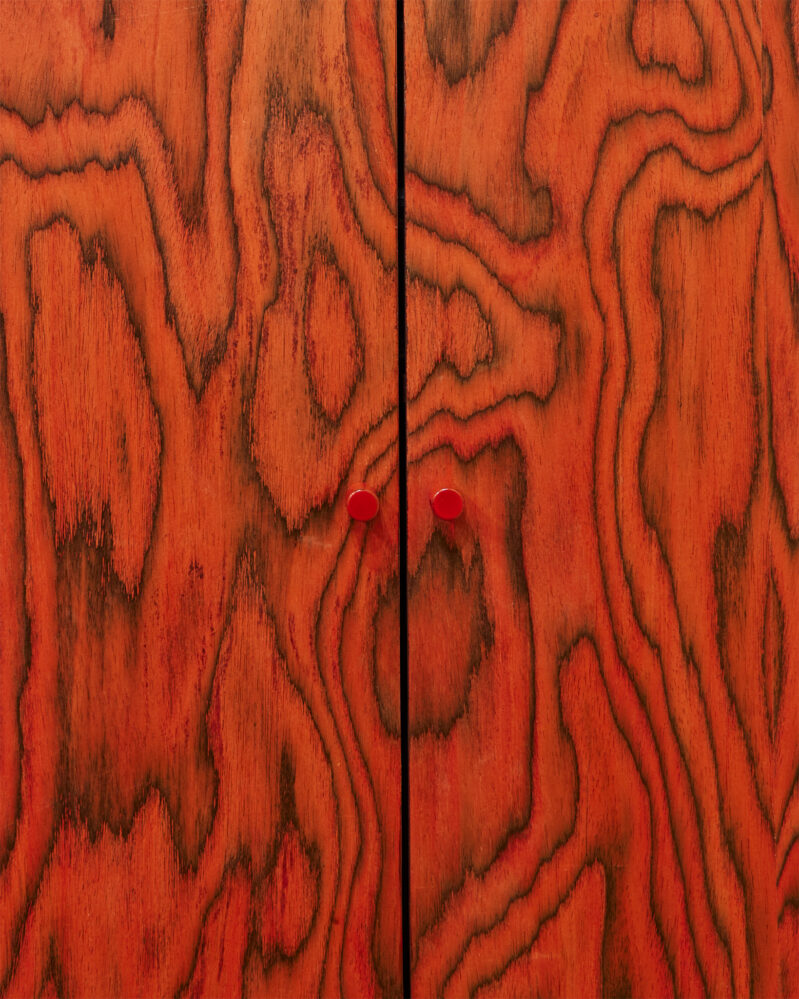
Sottsass began with the texture of natural timber and enlarged it to an oversized scale. The familiar figure of wood was magnified until it became a series of bold, rhythmic markings, with veining that ran dark and pronounced across a saturated base.
The pattern remained clearly timber, yet its markings existed nowhere in nature. ALPI describes the design as a meeting point between nature and human invention. Because the grain was designed, it belongs to Sottsass in much the way a drawing does, and each sheet of ALPI Sottsass is akin to having an original Sottsass design on your project.
Sottsass set the pattern in four colours, with ideas for future inclusions, each bringing out a different side of the design:
- Red, warm and theatrical
- Orange, recalling the colour of mid-century interiors
- Brown, closest to the timber it was inspired by
- Grey, graphic and almost architectural
- Pink, a celebration of colour, released in 2025 and drawn from Sottsass’s annotated journals and ALPI’s colour archive
Together, there is a shared sense of colour that runs through his work, where natural and synthetic tones meet on equal terms.
1985, the year ALPI Sottsass officially launches
ALPI Sottsass appeared for the first time in the 1985 Memphis Milano collection. The timing was significant, as 1985 was also the year Sottsass left Memphis to concentrate on architecture with his practice, Sottsass Associati. The group continued to present a collection at each Milan furniture fair until it formally dissolved in 1988.
However, the veneer outlived the Memphis movement with Sottsass continuing to use the pattern in later pieces. It has become part of the visual record of the decade, including both the furniture and objects that now define Italian design’s break with modernist restraint.
A centenary
In 2017, the year Sottsass would have turned 100, ALPI returned to the pattern, reissuing ALPI Sottsass in its four original colours and making the collection a permanent part of its range.
The relaunch took the form of Re–Connection, an exhibition at ALPI’s showroom on Via Solferino in Milan. Vittorio Alpi invited the designer Martino Gamper to respond to Sottsass’s design.
An archive of intentions
Vittorio Alpi describes ALPI’s collection as a library of woods, an evolving archive that each new design adds to and that future designers can draw on. Part of the archive includes Sottsass’s handwritten notes. Since the reissue, the collection has grown directly from those pages.
In 2022, ALPI’s research and development team introduced Sottsass Dark Brown. It was a deeper, more intense reading of the brown in the original Memphis palette, made possible by advances in ALPI’s timber dyeing techniques.
In 2025, the team turned to two Pantone swatches that Sottsass had included among his original colour proposals, one pink and one pale blue. The result is Sottsass Pink: a pink base colour with a pale blue veining. ALPI presented it at Milan Design Week in April 2025, alongside new veneers by Piero Lissoni, nendo and Estúdio Campana.
The language of a pattern
In the four decades since 1985, oversized and graphic timber grains have become part of the wider vocabulary of interiors. They appear in furniture, retail fit-outs, restaurants and homes around the world, and the language Sottsass developed with ALPI is part of this story.
For designers, a surface with a traceable history brings this iconic pattern and its story into a project. Specifying ALPI Sottsass by name connects a project to a chapter of design history that can’t be replicated.
From Modigliana to Australia
ALPI continues to produce ALPI Sottsass using the recomposed process it has refined since 1961. The process gives consistent colour and pattern from sheet to sheet, which allows Sottsass’s iconic design to run across large scale joinery and panelling installations. ALPIlignum veneers are FSC® 100 per cent certified, with full control of the supply chain from ethically managed forests to finished veneer.
In Australia, Elton Group is the exclusive distributor of ALPI and supplies ALPI Sottsass as part of our Eveneer Raw range.
Australian studios have taken up the pattern across residential and hospitality interiors, often as the focal material in an otherwise measured palette. For example, Greg Natale uses the Sottsass Grey at MacMasters Beach House across custom joinery, linking the home’s 80s heritage to this seminal design movement. Over in Cottesloe, WA, Rezen Studio has specified Sottsass Grey at Gibney, a brasserie overlooking the beach. And at Fiore Sandwich, ALPI Sottsass Red brings a bold counterpoint to the interior.
Each project shows a different expression of the pattern, from a single sculptural element to the material that defines a room.
In 2025, more than 40 years after it was first created, the conversation between Sottsass and ALPI continues with the release of a new Sottsass colour added to the range, Sottsass Pink.
Explore ALPI Sottsass in Eveneer Raw
FAQ
Who designed ALPI Sottsass veneer?
Ettore Sottsass, leader of the Memphis collective designed the pattern with ALPI in the early 1980s. It was first used in the 1985 Memphis Milano collection.
How do I know I’m specifying authentic ALPI Sottsass?
ALPI is the only manufacturer of the pattern Ettore Sottsass designed, and Elton Group is ALPI’s exclusive distributor in Australia. Specify ALPI Sottsass by name and colour, and source it through Elton Group to know you’re getting the real veneer.
Is ALPI Sottsass real timber?
Yes. It is a recomposed timber veneer, made from poplar, lime and ayous that is peeled, dyed and reassembled to create Sottsass’s pattern.
Where can I buy ALPI Sottsass in Australia?
Elton Group is the exclusive Australian distributor of ALPI and supplies the authentic ALPI Sottsass as part of our Eveneer Raw range.
Is ALPI Sottsass sustainable?
All ALPIlignum veneers including ALPI Sottsass are FSC® 100% certified, with full control of the supply chain.